
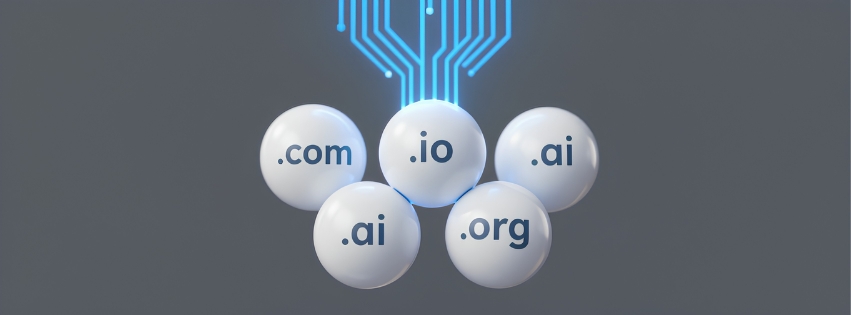
In the digital world, brevity carries power.
Short domain names are easier to type, easier to remember, and often perceived as more authoritative. They fit more naturally into logos, mobile screens, social profiles, podcasts, and casual conversation. In many ways, the internet rewards compression.
But the pursuit of shorter domains has also created an entire ecosystem of linguistic shortcuts — acronyms, alternate TLDs, numeric shorthand, dropped vowels, and symbolic language systems designed to compress meaning into smaller digital footprints.
The challenge is that compression and clarity are not always the same thing.
Some short domains feel inevitable. Others feel cryptic.
The art lies in knowing the difference.
Why Short Domains Carry Disproportionate Power
A short domain reduces friction.
It is easier to:
- recall,
- repeat,
- share verbally,
- display visually,
- and type quickly.
That matters more than ever in a world shaped by:
- mobile devices,
- shrinking attention spans,
- digital clutter,
- and rapid-fire communication.
Short domains also tend to project confidence. There is an implied authority in brevity. Companies with concise digital identities often appear more established, more focused, and more memorable.
But not all short domains are strong domains.
A four-letter domain with no recognizable meaning may technically be short, yet still fail to create memorability or trust. Compression alone is not the goal. The goal is efficient clarity.
The strongest short domains preserve meaning while reducing friction.
Compression Without Clarity
Every domain exists in tension between brevity and meaning.
A domain can become:
- too long,
- too literal,
- too generic,
- or too compressed.
For example:
- TB10.com feels compact and memorable.
- FLVR.com still suggests “flavor.”
- HQF.io feels concise and technical.
- XQZR.io may be short, but demands too much cognitive effort.
The human mind is remarkably good at pattern completion. We can often reconstruct missing vowels or infer familiar abbreviations. But there is a threshold where compression begins to harm recognition rather than improve it.
The eye can forgive missing vowels more easily than missing meaning.
That distinction matters
Alternate TLDs and the Rise of Digital Compression
One of the biggest shifts in modern naming has been the widespread adoption of alternate domain extensions.
For decades, .com dominated the internet. It still carries the greatest default authority and trust globally. But the scarcity and cost of premium .com domains has pushed startups toward shorter alternatives using:
- .io
- .ai
- .co
- .org
In many cases, these extensions allow founders to secure shorter, cleaner names that would otherwise be unavailable or prohibitively expensive on the .com.
For example:
Each creates a different emotional and strategic posture.
.io often feels technical and startup-native.
.ai signals artificial intelligence.
.co feels modern and venture-oriented.
.org can imply mission, community, or trust.
The extension itself becomes part of the brand language.
The Long-Term Strategy Behind Alternate TLDs
One of the more nuanced realities of modern naming is that alternate TLDs can function as transitional infrastructure.
A startup may launch on:
- VertexFlow.io
while preserving a future path toward acquiring:
- VertexFlow.com
That can be a perfectly intelligent strategy.
The important question is not simply:
“Can we launch on an alternate TLD?”
The more important question is:
“Is the .com realistically ownable later?”
There is a major difference between:
- a .com that is parked or privately held,
- versus one already controlled by a large, entrenched player in the category.
The best startup domains are not always the cheapest. They are often the ones that preserve optionality.
A company does not necessarily need the perfect domain on day one. But it should avoid building momentum on a domain path that can never fully mature.
Acronyms, Shorthand, and Semantic Compression
Many of the strongest short domains emerge not from arbitrary abbreviation, but from existing systems of compressed language.
Industries naturally develop shorthand:
- Rx for prescriptions or remedies,
- Dx for diagnostics or diagnosis,
- Tx for treatment, transactions, or transmission depending on context,
- HQ as a shorthand for headquarters or a central command point.
These forms work because they are already semantically loaded. They compress familiar concepts into smaller symbolic structures without completely losing recognition.
That is very different from random letter combinations.
The strongest compressed domains often feel fluent within the language of their industry. They signal familiarity, insider understanding, and semantic efficiency.
In technology, medicine, finance, and AI, compressed language is increasingly native to the category itself.
As industries evolve, so does their shorthand vocabulary.
Numbers as Compression Tools
Numbers can also function as powerful compression devices.
Consider:
- 360
- 365
- 101
- 24/7
- 10
These numbers already carry embedded meaning:
- completeness,
- continuity,
- foundational learning,
- always-on availability,
- rankings,
- or curation.
For example, TB10.com compresses the idea of “Tampa Bay Top 10” into a concise and memorable structure.
The number is not random. It contributes semantic meaning while reducing character count.
That is effective compression.
Again, the question is not merely:
“Is it shorter?”
The question is:
“Does the meaning survive the compression?”
The Rise of Vowel Dropping
Another increasingly common strategy is vowel removal.
Domains like:
- FLVR
- GRMR
- FLICKR
- Scribd
demonstrate how the mind can reconstruct missing information.
This allows brands to:
- shorten names,
- improve availability,
- create visual compactness,
- and reduce acquisition costs.
But vowel dropping also carries risks.
At mild levels, the brain fills in the gaps naturally. At more aggressive levels, readability begins to collapse into friction.
Some compressed names feel modern and efficient. Others feel forced or cryptic.
The strongest examples preserve recognition while reducing clutter.
Shorter Isn’t Always Better
One of the biggest misconceptions in domain strategy is that shorter automatically means stronger.
Sometimes a slightly longer domain creates:
- more trust,
- more clarity,
- stronger emotional resonance,
- or greater memorability.
A domain like:
may carry far more identity value than a shorter but semantically hollow alternative.
Likewise, a domain such as:
- PrimeTopology.com
may be longer, yet conceptually powerful because the language itself feels inevitable within the category.
Clarity and meaning still matter.
Perhaps more than ever.
The Future of Digital Identity
The modern internet increasingly rewards compression.
But the future will not belong merely to the shortest names.
It will belong to the names that compress meaning intelligently.
The strongest domains reduce friction while preserving:
- memorability,
- clarity,
- authority,
- and strategic flexibility.
That balance is both an art and a strategy.
And as digital identity becomes more valuable, the ability to compress meaning without losing clarity may become one of the defining branding skills of the modern era.